
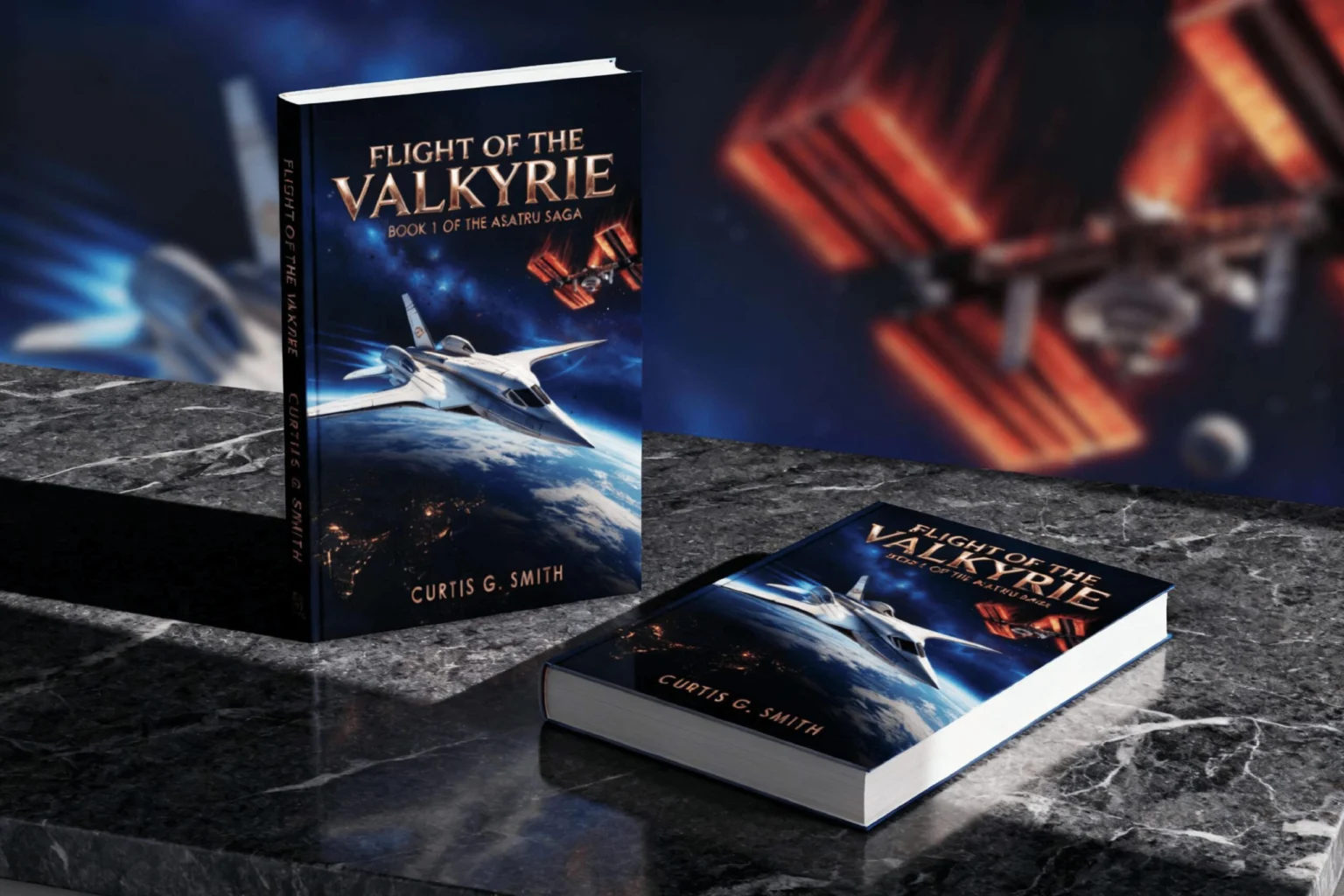

12 responses to “Flight of the Valkyrie – Book I of the Asatru Saga”
-
Chapter 1
The International Space Station, 250 miles above Earth
Claire stared out the window at the swirling clouds awestruck. The view never got old. It was so mesmerizing that she lost track of time while under its hypnotic spell, just like everyone else who looked out at it. Only a small handful of people ever get to see their home the way she did. From two hundred fifty miles up, the planet looked serene and quiet. There were no signs of any human struggles, political boundaries, or senseless conflicts from here. From orbit, Earth was a beautiful, bright blue and white marble peacefully floating in the blackness of space. The idyllic image belied what sometimes went on below, however.
Underneath the clouds, people went about their daily lives, trying to survive and find some happiness in uncertain times, while governments vied for power and supremacy. From every corner, quiet courage keeps the world turning. That much has not changed in the whole course of human events. Tragically, though, volumes of books on the history of humanity could easily be written in the blood of countless innocent souls who have perished in the innumerable wars that have been fought since the dawn of civilization. Individual needs have always been in juxtaposition with national agendas.
Despite separation in time, distance, and culture, all the conflicts had one thing in common. They had all been fought over the most precious commodity on the planet, land. The Earth hasn’t grown, but the number of people has, putting an increasing and excruciating strain on limited resources. Today, the stakes are higher than ever before because countries have a far more lethal arsenal of weapons in their hands to play the dangerous game of global brinkmanship.
Above the clouds, Claire couldn’t see the devastating effects of the Ukrainian-Russian War, with the ruins of Kyiv still smoldering and the long, dismal line of refugees desperately trying to leave the country. Similarly, hordes of tanks, thundering across the Sinai Peninsula, were far too small for her eyes to discern. Even the buildup of ships and troops in eastern China was so minuscule that it couldn’t be detected from her lofty vantage point.
For the moment, space was unspoiled by conflict, but that was quickly changing with advancements in technology. Some countries had even declared orbiting objects legitimate military targets and space as a new warfare domain. Claire shuddered at the idea. She found it inconceivable that up here could be anything but peaceful. Even though she knew what went on in the world below, she could at least pretend from her lofty perch that it temporarily didn’t exist. Like a giant eagle, she looked down from her aerie to see a vast and beautiful world untouched by human incursion.
This was her favorite place to hang out during her brief free times. The sight of an untroubled Earth, even if it was a façade, provided her with comfort and security. She had her own demons to deal with, and the cupola gave her an escape from them. It was her little private sanctuary.
In actuality, the cupola had been installed on the International Space Station not just for Claire, but as an observation point to provide unbridled 360-degree views of space and Earth. Its seven large windows provided astronauts with an unobstructed vantage point to monitor the long robotic arm and the space shuttle docking ring. When it was not being used for actual station operations, and it coincided with her scarce downtime, Claire used it as her own personal retreat. She could usually be found relaxing inside, meditating with her eyes open as she took in the magnificent view.
She floated in a fetal position with her arms wrapped around her curled-up legs and her bright red hair drifting freely above her head. The air currents had gently pushed her against the window until her forehead touched the cold glass. Only five inches of transparent aluminum plates separated her from the warm and safe environment of the station to the cold and lethal vacuum of space. When she looked out of these same windows for the first time, she was very aware of that fact. Now, after over six months in space, she had almost forgotten the precarious and dangerous conditions in which she lived.
Veteran astronauts tend to become complacent after a while in space. They learn to trust the technology implicitly. They have to, or they would go crazy constantly worrying about what was outside the station’s thin metal walls. Sometimes, bravado is the only thing that keeps your sanity when you’re cooped up in a flying tin can that’s hurtling over eighteen thousand miles an hour above the Earth.
Right now, she wasn’t concerned about the dangers of living in space. She was enjoying the tranquility of the moment. She continued gazing out as the Earth passed silently beneath her. Her bright emerald eyes didn’t blink as they stared in fascination.
Behind her expressionless mask, Claire thought of her family and the ranch in Wyoming. She hadn’t been back home in too long. Her career had taken her all over the world, and now above it. There was always something that got in the way whenever she thought about visiting her family. A memory of riding her horse across the grassy plains unexpectedly appeared in her mind. She looked down as they crossed North America and squinted, trying to see if she could make out the Grand Teton Mountains.
The station’s intercom jarringly intruded, breaking into her temporary solitude.
“Claire, you’re needed in the Columbus module,” Commander Ellis’ voice chimed from the bulkhead speaker.
Claire deftly reached up and pushed the communication button.
“On my way,” she replied with a bit of irritation seeping into her voice.
Damn it. It was probably something unimportant and trivial again, she thought.
With a gentle push, she turned around to exit the Cupola and trek all the way across the station to its other end. The ISS, she learned, is like a long, interconnected labyrinth of high-tech modules, part science lab, part spaceship, part home. She could navigate it blindfolded. Each module was designed and built by the different countries that formed the space-faring alliance that collectively developed the orbital outpost. It was a grand achievement of international cooperation in space exploration. The mission patch she wore on her right shoulder depicted the ISS ringed by the flags of the countries that supported it. She was proud to be part of something much bigger than herself.
The zero-gravity made transversing the station very effortless. She had to remind herself, however, to stay in the center of the passageways. Every surface, the floor, walls, and ceiling, was used because there’s no ‘up’ or ‘down’ in zero gravity. All the space was needed for the plethora of scientific studies that the crew was conducting on behalf of researchers all over the world.
She had been put on the crew roster as an assistant to the two French scientists from the European Space Agency, the ESA, who arrived last month. She rued the bad luck of the draw that assigned her to this babysitting duty. She had other, far more important responsibilities. She understood that all the crew had additional collateral jobs due to the nature of living and working in a cramped area while trying to maximize their time in orbit, but that understanding didn’t take away the drudgery of the task. She sucked it up, knowing it was all in the name of science.
The French astronauts were conducting experiments on how bees could pollinate in microgravity. They were probably good scientists, she surmised. However, she felt they took her position as an assistant a little too literally. They treated her like a rookie graduate student and continually relied on her for tasks they couldn’t possibly do themselves.
She wondered what it was this time, as she floated her way through the station to the science module. Last time, one of the scientists had accidentally let a few of the bees out of their little habitat. The poor creatures were valiantly trying to fly in zero gravity but had problems orienting themselves. They would run into each other with one legs-up and the other legs-down.
The scene was made even more comical by one of the scientists frantically swatting at his little charges with a binder. His fanning-like motions had propelled him to the far end of the module, where he was pinned against the bulkhead, still swinging away. Ironically, it turned out he was scared of bees.
Claire snickered to herself, remembering the incident. Hopefully, all the bees were safely contained. It took her almost an hour to find and carefully collect all of them last time.
It’s not that she minded helping conduct genuine scientific research. It was just a little demeaning to be at the beck and call of two prima-donna researchers in space. She knew she had earned her spot on the station the hard way.
She was proud to have attended the United States Naval Academy and graduated third in her class, majoring in aerospace engineering and minoring in applied mathematics. Her class standing and other accomplishments set her on the path as a Naval aviator. She qualified for jets and was selected to fly the brand-new F-47 Stingray.
She was proud that she excelled as a pilot too. Her eight years in the cockpit had seen her fly twenty combat missions over the Middle East. The Distinguished Flying Cross proudly displayed on her uniform testified to her skills and bravery in the air. Those skills, along with her academic degrees, had earned her a coveted spot in NASA’s astronaut training program. Graduating at the top of her astronaut class put her on the International Space Station crew rotation. Yet, despite all her accomplishments, here she was playing orbiting nursemaid to some needy scientists.
Oh well, she thought. The view is worth the sacrifice.
Claire reached the hatch to the Columbus module, grabbed both sides of the circular frame, and gently pushed herself inside. Both scientists, Dr. Pierre Fontaine and Dr. Luke Dubois, were there. They seemed to be intently studying something under a microscope and did not immediately see Claire floating in. She let her momentum carry her right up next to them, unnoticed.
“You needed something?” she asked, feigning politeness.
Her unexpected presence startled the men. Dr. Dubois suddenly looked up. His jarring motion caused him to float away from his partner in a slow somersault. Claire almost laughed out loud, but kept a respectful silence.
“Oh, good, you are here,” said Dr. Fontaine in a thick French accent, the kind that many Americans always find a little condescending. “We need help establishing a communication feed that will connect with the station’s computer system and allow us to transmit video of our bees back to our colleagues at ESA in Paris,” he explained.
“Ok, that should be fairly simple,” she replied outwardly.
Inwardly, she allowed herself a different response. “Really! That is what you called me here for?” she silently screamed in her head.
She took a deep breath to compose herself and told them as courteously as she could muster, “I’ll be right back.”
“Yes, yes, merci,” Fontaine responded with a slight wave of his hand, not looking at her.
Claire rolled her eyes and pushed out of the module and into the long tunnel formed by the Harmony, Destiny, and Unity modules joined end to end. Together, they made seventy feet of unobstructed free space. It was the location where all first-timers to the station played Superman by propelling themselves from one end to the other with an arm stretched out in front. It was the ultimate selfie shot. Claire swore she wouldn’t do something that corny when she found out she was going to crew the station, but succumbed to the temptation once she got here. She had to admit, it was fun.
At the moment, the tunnel was devoid of crew members, which was a rare occurrence. It momentarily struck her as odd, but then she remembered there was an EVA planned for the morning. Morning was an arbitrary term in orbit. They experienced sixteen sunrises and sunsets in a twenty-four-hour day. Therefore, NASA set the ISS to Greenwich Mean Time to better align it with humans’ natural circadian rhythm.
She made her way down the tunnel, navigating around a tangle of wires, equipment, and hoses strewn throughout the modules to support the various station functions needed to keep their little world running around the clock. The station resembled a junk shop, but it was functional. Since they never got company, they never worried about tidying it up.
They also never worried about the smell. Every astronaut who had ever served aboard the station described it differently, and never in a pleasant way. When she took off her helmet for the first time coming to the station, it hit her olfactory senses like a sledgehammer blow. The best she could describe it was a combination of hospital and locker room. Luckily, after a few days, her nose gave up trying to process the offending smell and became dormant. Unfortunately, she couldn’t smell herself either to know if she was adding to the unpleasant aroma.
As she floated through the Destiny module, she noted the varied experiments being conducted. Destiny was the U.S. Laboratory component of the station and, as such, hosted some cutting-edge research projects.
Her other charge, a hybrid soybean plant, seemed to be faring well. A botanist was testing whether the plant could grow in microgravity in anticipation of a Mars mission. Maybe someday it would, Claire thought.
Destiny also served as the central corridor through which everyone passed, making it a hub of activity. So, it tended to look like a disorganized mess to the untrained eye. Claire, however, knew every knob, cable, dial, and screen in it.
She had just passed through the area to get to the Columbus module and hadn’t noticed anything amiss. This time, however, she saw that an access panel had been removed from an equipment rack and left floating beside it.
Carelessness like that offended her military training. She frowned and stopped to secure it back in its proper place, and made a mental note to mention it at their next crew briefing. Once she was satisfied it was back where it should be, she continued along the tunnel.
In the last module, she turned left into the Quest Airlock. Inside, Station Commander Ellis was helping Michelle and Peter suit up for EVA. They were next on the roster to do some scheduled maintenance and repairs on the outside of the station. Keeping the ISS running was a never-ending chore. As with all the work around the station, the crew took turns and shared the load.
“Hey, guys. You look like you’re about ready to head out,” Claire greeted them.
“Ya. Somebody’s got to work around here,” Peter joked.
“I’ll trade you. You can wait on Fontaine and Dubois and I’ll do the EVA,” Claire offered, not joking.
“No unauthorized changes to the duty roster,” Commander Ellis told her. “Besides, they requested you.”
“Bullshit,” Claire remarked.
“Peter pissed them off. They won’t work with him anymore. And since I’m the station Medical Officer, I get out of it,” Michelle told her.
“How’d you piss them off?” Claire asked.
“It was easy. I’m German,” Peter quipped.
“Hmm. Maybe I could start faking a German accent,” she mused.
“Nein, you’re too ginger. It gives you away as Scottish. Plus, you’re prettier than me,” he said.
“That’s sexist,” she feigned indignation.
“But true. You know French men. Oui, oui,” he teased.
Michelle and Claire laughed as Peter made an exaggerated pantomime of hugging and kissing his empty spacesuit top.
“Alright, let’s keep it clean and professional, people,” Commander Ellis told them.
“Sorry, Commander,” Peter apologized but winked at Claire on the side.
She smiled and winked back to show she was not offended.
“With that, I’ll leave you to your EVA. I’m in search of a long HDMI cable. Any suggestions?” she asked them.
“Try the Russians, they usually have a bunch of spare cables,” Michelle offered.
“While you’re at it, would you please check the external proximity sensor array? It went down last night and I haven’t had time to figure it out,” Ellis asked.
“Ok, I will,” Claire promised.
Claire left the airlock and headed further down the tunnel to the connector adapter that joined the Russian Zarya module to the rest of the station. The Zarya module, also known more technically as the Functional Cargo Block, or FGB, was the first component to be launched for the ISS. It was the beginning of the orbital outpost’s assembly back in 1998.
She passed through the narrow connector into the “Russian” side of the station. Even though it was all the “International” Space Station, the Russian Orbital Segment was built, owned, and operated by Roscosmos. Americans were welcome there and vice versa, but due to increased tensions between the two countries, an unspoken arrangement essentially divided the station into two territories.
“Anyone home?” she called out over the din.
The entire station was loud due to the incessant noise of circulation fans, cooling pumps, and electronic equipment, all of which produced an annoying seventy-two decibels. The Russian segment was notoriously even louder. Their less stringent design requirements produced a cacophony that made hearing very difficult.
“Hey, anyone home?” she asked again, louder.
The question was rhetorical. Of course, Yuri and Dimitri were there. The two Russian cosmonauts couldn’t have gone anywhere. It was Claire’s way of being polite whenever she went to see them.
“No one is here right now. Please come back later,” Dimitri’s standard friendly answer echoed from inside.
“Howdy, I was wondering if you had a long HDMI cable I could borrow? It’s actually for Fontaine, but I’m his gopher today,” she asked.
“Gopher?” Dimitri repeated, confused.
“It’s an old American slang term for ‘go-for-this and go-for-that,’” she explained.
“Ah, I get it. A joke,” he replied with a laugh. “Let me see.”
While Dimitri rummaged through some lockers, Yuri floated in. He seemed surprised to see her there and hurriedly pushed himself back through the connector to the other module. In his haste, the large metal canister he was holding slammed into the bulkhead with a loud crash. He quickly cradled it close to his body with a worried look. Nervously, he turned it over and over, closely inspecting it for damage. Satisfied that it was ok, he breathed a sigh of relief.
“What are you working on?” she asked casually.
Yuri looked at her a little suspiciously. “Just some new electronic equipment installation,” he told her guardedly.
“Sounds like fun. I’m doing some electronics stuff too,” she said cheerfully, trying to strike up a conversation.
Yuri disappeared into the adjoining Zvezda module without another word. He was usually a very cordial crewmate who enjoyed hearing and sharing stories with the rest of them. Lately, he seemed pretty tight-lipped and distant, though. Claire knew from experience that long space missions affected people differently. The isolation, monotony, confinement, and, most of all, the absence of loved ones, wore on every astronaut, regardless of how seasoned. She worried he was falling into depression.
“Here is a cable. You may keep it,” Dimitri said, producing a long black cord.
“Is Yuri ok?” she asked him.
“Da, I think he is. He has been working by himself for the last few days and doesn’t talk much. Maybe he is homesick? I will check on him,” he told her.
“Thanks,” she said. “And spasibo for the cable,” she added in Russian.
Claire made her way back to the ESA module to assist Dubois and Fontaine with their data network setup, before they began calling over the intercom for her.
Inside, she found the two French scientists hovering over their bees and taking notes.
“I got the cable!” she told them triumphantly.
“Merci, the computer port is over there,” Dubois said, absently pointing to a panel on the upper bulkhead and continuing to write down his observations of bee behavior, which he obviously found fascinating. Apparently, bees are so intriguing that he forgot how to be polite, Claire noted.
Her look could have shot daggers at the scientists. She thought about a snarky comeback but decided against it. Instead, she just sighed, resigning herself to her fate, and pushed off in the direction of the port. Sometimes silence is the best answer, she reminded herself.
When she reached the port, she spun around agilely to plug in the HDMI cable. Suddenly, a loud crash reverberated through the module, violently shaking the entire structure. An instant later, the alarms blared through the station. Before she could reach the module hatch, Commander Ellis’s voice burst out from the station’s intercom.
“Secure all hatches immediately! I repeat, secure all hatches immediately,” he ordered. There was a clear tone of urgency in his voice.
Claire obediently grabbed the module hatch and pulled it inward. She quickly turned the locking mechanism and sealed the three of them inside. She then spun around to look out the module’s only small window. As she peered outside, she let out a loud gasp.
-
I really enjoy how the reader gets to know a little bit about Claire before the action starts, and it starts right away. There is a bit of humor sprinkled in that suggests the author wants the reader to have fun alongside the characters. The science is spot on, which I really appreciate.
-
-
Chapter 2
Jefferson National Forest, Virginia, 3,500 ft elevation
“Wait up!” yelled Rachel. “I’m not as fast as you.”
Steve looked back and smiled.
“You need to pick up the pace,” he chided.
Rachel frowned and continued up the steep slope. The thirty-pound pack weighed heavily on her small frame. Despite the burden and rough terrain, he knew she was determined to reach the top. She was not about to let him get to the peak without her. He also knew that she really loved him, but didn’t want to see his smug look if she quit now. They had made a bet on who would drop out first from trying to summit the mountain. The loser got the embarrassment of wimping out, along with kitchen duty for a month. The winner could brag from the comfort of the living room couch while the other one cooked.
“Ha, passing you on your left,” she triumphantly declared as she proudly strode by him.
Steve just smiled and let her take the lead. He fell in behind her as they continued up the trail.
“I like this view better anyway,” he teased.
Rachel looked back and rolled her eyes.
“Men,” she moaned.
Steve smiled and let his mind wander as they hiked. His thoughts quickly drifted to his relationship with Rachel and his career ambitions. His two passions seemed finally within reach, which both excited and scared him.
He had met Rachel through a mutual friend. Her best friend knew his best friend type of thing. They went on a blind double date to a movie and dinner. The movie was bad, and the dinner was mediocre, but she and Steve hit it off.
They were both outdoor enthusiasts who enjoyed activities such as hiking, kayaking, and biking. They were also both into late-night couch-potato surfing. They binged-watched every season of the latest hyped-up television series. Most importantly, they enjoyed each other’s company.
Steve made her laugh. He had a dry, but funny, sense of humor that she appreciated, while few others did. She, in turn, provided Steve with some much-needed stability in his chaotic life.
Steve, or in full Lieutenant Commander Steven Paige, was a former Navy fighter pilot. He lived on adrenaline and jet fuel. He exemplified the part too. With bright blue eyes, dark brown hair, and a six-foot-even athletic frame, he looked like he stepped right out of a recruiting poster. It was one of the characteristics he was aware of that attracted her to him. He hoped that there were other things, too. He constantly tried to prove to her that he was more than just a jet-jockey and win her approval.
He was a good pilot, though. His service career was marked by daring missions in the air over Iraq and Afghanistan, which had earned him several medals, including the Distinguished Flying Cross, while his exploits on the ground had earned him the unofficial callsign “Turbulence.”
His real passion, however, was higher up, much higher up. Since he was a young boy, Steve dreamed of going into space. That is why he applied to the Naval Academy. His ambition drove him to study hard, and play hard, too. Which is why he had earned the reputation at the Academy of being, as his company commander noted in his final evaluation, “a dedicated and gifted midshipman with a penchant for breaking the rules.”
Despite a few demerits for minor infractions, Steve made it into the cockpit. He flew with the Navy for ten years. During that time, he earned the respect of his fellow aviators and ground crew not just for being an ace pilot but also for being a good leader who genuinely cared about his shipmates. He led by example and was always willing to selflessly sacrifice himself for them and his country. He was aware of the risks and accepted them as part of the job.
When not in the cockpit, Steve continued pursuing his dream. He put in a few hopeful applications to NASA for astronaut training. Unfortunately, each time the selection board responded with a rejection letter.
Steve was about ready to accept that flying his fighter off the carrier was the closest to orbit he was going to get. Then, out of the blue, he got wind of a small start-up aerospace company called Event Horizon, which had announced they were seeking skilled and experienced test pilots for a new spaceplane they were developing. Without hesitation, he applied.
A few weeks went by and then a letter arrived from the company inviting him to an in-person interview. He took some leave and flew up to the company headquarters in Seattle. The interview went very well. On the spot, they offered him the position, and he accepted immediately. He returned to San Diego and the next morning submitted his request to transfer to the reserves. Reluctantly, his commanding officer approved it. Now he was wholly committed to the program.
Rachel, on the other hand, was much more sedate and grounded, which Steve reluctantly acknowledged he needed in a partner. She was doing her residency at Cape Canaveral Hospital and worked long and erratic hours, but always made time for him. She made him feel special.
She was the girl-next-door type of pretty, cute, but not too glamorous. Her short, blond hair framed her lightly freckled face, which was accented by deep blue eyes and pouty lips. Steve found her irresistibly attractive.
He understood that her job made it difficult for her to have a social life, so he appreciated the times they had together. The hospital got the lion’s share of her attention. By the time she got home from work, she was exhausted. On her days off, she had gotten into the mundane routine of hanging out at her condominium with Stanley, her only love interest until Steve.
Stanley was a good companion, but a strong, silent type. He enjoyed taking walks, curling up to watch movies, and sharing meals. He wasn’t great at conversation, though. He just looked up at her with those big brown Golden Retriever eyes whenever she confided some personal problem in him. She would talk, and he would listen and then offer a paw or roll over to get his chest scratched as compensation for providing therapy.
Steve and Stanley had a little bit of rivalry early on. It took a little while for the dog to accept that someone else would be hanging around. He had been the sole object of his owner’s affection for his entire life and wasn’t accustomed to sharing her with anyone. Steve eventually won him over with snacks and endless games of fetch, though. They reached a truce, accepting that there was room for both of them in her life.
Steve and Rachel had been together for almost a year now. He did not know exactly where they were heading, but he didn’t really care either. Right now, he was content to have someone in his life with whom he could share things, and he knew Rachel wanted to have a life away from work again, even if it was while sweating and gasping her way up the side of a mountain.
The hike up Mount Rogers was not particularly difficult, but it was a good workout for her. Steve was accustomed to much taller peaks back in his native Washington State, but he didn’t want to scare her off on their first camping trip. This was her chance to prove that she would and could hang with him.
They had planned this weekend’s backpacking trip to get away from the craziness of Cape Canaveral and the brutal Florida heat. He hoped it was a chance for them to deepen their connection by sharing some quality time in nature. The Appalachian Mountains might not be as tall as the Cascades, but they still offer some breathtaking views of the Virginia countryside.
They continued hiking and enjoying the smell of red spruce and magnolia as they gazed down into the deep valleys. Not a sign of civilization was to be seen. This was exactly what he had in mind when he planned the trip.
That afternoon, they found a small glade carved out of the dense forest where the surrounding trees formed branching columns that supported a clear, blue dome overhead. Filtered sunlight shone down on green grasses dotted with colorful wildflowers, while flying insects restlessly darted from one bloom to another in constant motion, and a nearby creek filled the air with its tranquil melody. The sweet smell of fresh growth, mixed with the musky scent of crushed leaves and fallen pine needles, rose to permeate the air, reminding visitors of nature’s endless cycle.
Stepping into the glade, Rachel and Steve felt like they were entering another world, where time stopped. Outside, the world kept going, but inside, it was just them. Simultaneously, they heaved a sigh of relief and felt their cares fall off their shoulders.
They lightened their load even more by unbuckling and dropping their heavy packs. Rachel rolled her sore shoulders and winced a little. Steve looked over at her and smiled.
“You doing OK?” he asked.
She arched her back. “Yes, I’m just stretching,” she answered, trying to cover for the pain she was feeling.
“Good. I’m going to set up camp,” he told her.
Steve busied himself with the tent while Rachel rummaged through her pack, looking for a fresh shirt to exchange for the sweaty one she was wearing. Within a few moments, the tent was up and they moved in. The down sleeping bags felt better than any bed after their long, arduous hike.
Steve rolled on his side to look at her. “Thank you for coming,” he said.
Rachel smiled back. “Who needs a luxury hotel, when you have all this?” she teased, sweeping her hand around the sparse tent interior, and kissed him.
That night, Steve built a small fire, and they sat under the stars wrapped together in a blanket. He pointed out the different constellations as Rachel snuggled against him to keep warm. Eventually, he stopped talking and simply enjoyed their solitude. The sound of the creek and the occasional hooting of an owl were the only sounds they could hear over the crackling of the fire.
“Do you think you will ever get up there?” Rachel asked drowsily.
“I hope so. It’s all I ever wanted, until now,” he told her.
She smiled and buried her face in his chest. Steve continued to look up at the stars, wondering if his gamble with leaving the Navy for the civilian sector would pay off. the Valkyrie would decide his fate.
Valkyrie was the code name assigned to the company’s new spaceship, which they were developing to join the rapidly growing space race. If successful, it would be a game-changer in Earth-to-orbit and beyond space transport. It would also be the vehicle to possibly lift Steve into the heavens.
Entrepreneur Richard Stafford had invested millions of dollars in his latest venture. He specifically founded Event Horizon for the project. The new technology involved an exotic propulsion system that utilized a pulsed plasma drive. NASA had agreed to rent an assembly and launch facility at Cape Canaveral for the ship, which is how Steve ended up in Florida. It was nearing completion for a trial flight, and Steve was its test pilot.
He looked at Rachel, who had fallen asleep. One side of him wanted to blast off tomorrow into the unknown; another side wanted to stay with her like this forever. He hoped that the two paths weren’t mutually exclusive. Navy life had shown him just how difficult it was to balance a career and family. “Could I have both?” he wondered.
The fire had died to a few, last glowing embers, allowing the cold to seep into their cocoon. He roused Rachel, and they climbed into the tent and the waiting warmth of their sleeping bags. He fell asleep wondering what the future might hold for them.
The next morning, they reluctantly packed up camp and re-shouldered their backpacks.
“This is the last push for the summit,” Steve told her.
“Lead on. I’m not quitting,” she replied firmly.
With her affirmation, he marched out of the glade and back into the forest and the awaiting world.
A short while up the trail, Steve’s phone unexpectedly rang. The electronic buzzing seemed oddly out of place in the hush wilderness. It echoed awkwardly in the canyon they were passing through.
“Really, I thought you turned that off?” asked Rachel, irritably.
“Apparently, I forgot,” answered Steve.
He took the slim phone from his hip pocket and glanced at the caller ID on the screen.
“It’s Sam,” Steve called up the trail to Rachel.
Sam was the project manager for Event Horizon. He oversaw the Valkyrie program. Despite being vastly different, he and Steve had become good friends. The unlikely pair formed the backbone of the company.
“Whatever he wants, it can wait until Monday. We’re here to climb a mountain. You better get the lead out or I’m going to beat you to the top,” she teased.
Steve hesitated. He knew that Sam was very mindful of calling on the weekends. He looked at the screen for a moment, debating whether to answer the call. Before he could decide, it stopped ringing and automatically went to his voicemail. He waited a moment longer. A text message popped up.
“It’s Sam. There’s been an accident on the ISS. I need to get a hold of you ASAP,” it read.
“Shit,” said Steve under his breath. I knew I should have answered it, he rebuked himself.
He tapped the dial button and the phone rang. Sam did not answer. When it went to voicemail, Steve hung up in frustration.
“Shit,” he said again.
“We’ve got to turn around and head back to the Jeep,” he yelled up to Rachel.
Rachel was out of sight. She had continued up the trail to get a lead on Steve while he dealt with his phone. She had rounded a large rock spur and was no longer in view or hearing.
“Shit,” said Steve for the third time.
Steve shook his head and trotted up the trail in pursuit of his girlfriend.
-
These two scenes are juxtaposed, space and the forest, to show the different personalities of Claire, calm and introverted, and Steve, outgoing and extroverted, while also showing the adventurous nature of both. Great scene descriptions allow the reader to immerse themself in the mountains with Steve and Rachel.
-
-
Incredible!
-
These are compelling introductions to these characters. I look forward to reading more!
-
Chapter 3
Kennedy Space Center, Cape Canaveral, Florida
Sam put his phone down on his desk. Steve hadn’t picked up. He needed to get in touch with him quickly.
A young man in a thin blue tie and khaki pants came hurriedly up to him from across the crowded room.
“Sam, the director needs you ASAP,” he beckoned.
Sam sighed and reluctantly followed the man. They went outside to an awaiting golf cart. The director’s office was in another building, so the ride was very welcome. The sprawling complex made walking to other areas difficult, especially under the scorching Florida sun.
“Any idea what he wants?” Sam asked along the way.
“I don’t know and I don’t ask,” the driver responded.
“Fair enough,” Sam agreed. The director’s reputation as a hard-ass was well established within the agency.
They pulled up in front of the massive Launch Control Center, where the director had set up a temporary office. Normally, he worked from the Johnson Space Center in Houston, but due to the current emergency situation with the International Space Station, he had relocated to the Kennedy Space Center to be closer to the center of the action.
The Launch Control Center sat adjacent to the gargantuan Vehicle Assembly Building (VAB). NASA’s centerpiece is a study in scale, so vast it seems less constructed than placed on the landscape. Rising five hundred twenty-six feet above the flat Florida scrub, the building dominates the horizon like a sheer white cliff. Its exterior is stark and industrial, paneled in large, smooth sheets of metal, broken only by vertical seams and the immense U.S. flag and NASA insignia painted on its face.
Despite its brute scale, the VAB conveys restraint and discipline. Every beam, bolt, and open volume exists for a purpose, which is to assemble machines meant to escape Earth entirely. Standing within it, the human sense of proportion dissolves; people shrink to moving dots, and the building becomes not merely a structure, but an environment, one built to make the impossible routine.
The mighty Saturn V rockets and the space shuttles were all assembled in it. Its latest inhabitant was the Artemis rocket, which was the heavy-lifting component of NASA’s Space Launch System. It was designed and built to return humans to the moon. Unfortunately, it was delayed and was at risk of being defunded and scrapped. If Event Horizon succeeded, then the whole structure and its contents would become obsolete anyway.
Sam only briefly admired the structure. His driver was out of the cart and quickly walking to the entrance before Sam could unbuckle. He hastily caught up just in time to squeeze through the door behind him.
Inside, Sam trailed after the man through a maze of featureless hallways and offices. Why did the director want to see him? As a civilian contractor merely leasing space at Cape Canaveral, he rarely had contact with NASA officials. He racked his brain trying to figure out what he had done now and formulate an explanation for whatever it was. Finally, they reached the director’s office so he could find out.
The young man knocked twice and waited for a reply.
“Enter,” a gruff voice bellowed from inside.
He opened the door for Sam to go in.
“Here he is, sir,” said the man and left quickly, closing the door behind him.
It was not an impressive office, especially not for the Director of NASA Flight Operations. He expected it to be more elaborate and dignified. Then again, he surmised, this is a government operation, not the private sector Sam was accustomed to. Aside from old pictures and Marine Corps Aviation memorabilia on the wall, the only other items in the office were a pathetic-looking potted plant in the corner and a faded leather chair behind a large wooden desk, which was strewn with papers, charts, and used coffee cups.
Sam cautiously approached the desk. The director was standing behind it, talking loudly on the phone. He held up an index finger, indicating for Sam to wait while he finished his business.
He was a tall man with sharp features and thinning grey hair that was still neatly trimmed in a high-and-tight military cut. His white shirt was crisply ironed and inspection-ready. On his red tie, a shiny gold Marine Corps emblem was proudly displayed. He exuded a command presence that everyone at NASA respected and obeyed. This is a man used to being in charge, Sam had come to learn.
“I don’t give a damn what the holdup is! I want those numbers within an hour! Get more people on it if you need to,” barked the director to some poor subordinate on the other end of the call and then abruptly hung up.Tim Willits put down the phone and focused his intense blue eyes on Sam.
“Sam, right?” inquired Willits.
“That’s correct, sir. Sam McKinley. I’m the project manager for Event Horizon. With our CEO out of communication for a bit, I have the authority to act in his place.” Sam answered, trying to muster confidence.
“Good. We might need your help,” replied Willits. “As you know, the ISS was hit by a big piece of space junk. It took out the Zarya Control Module along with two Russian cosmonauts. Without the Progress spacecraft docked to it, the station has no way to boost its altitude. Right now, it’s spinning out of control and falling fast. The crew is trying to use the gyroscopes on the main truss to stabilize the station. Time is our biggest problem at the moment,” he explained.
“What can we do?” asked Sam, eager to help.
“We could use some extra help with computing power. Our local servers are overloaded thanks to this storm taking out our link to Houston. We’re on our own here at The Cape. Any help would be greatly appreciated,” explained Willits.
“Not a problem. We’re happy to help. We have an IBM Supercomputer on site that pushes out ten petabytes of RAM,” Sam boasted.
“Great, thanks. I’ll let our people know,” Tim replied and went back to shuffling through some reports.
Sam guessed that was the end of the conversation and saw himself out. He walked out of the director’s office and back outside. The man with the golf cart was gone. Having no other option, he walked the long way back to his office.
This had turned out to be a Hell of a Sunday morning, so much for his day off. First, the hurricane barreled into the Gulf of Mexico a day ahead of schedule. Luckily for them, it drifted west, not north, up the Florida coast. Cape Canaveral had dodged the storm, but Mission Control in Houston had taken it head-on. Second, the ISS was struck and crippled. The crew onboard had few options and was running out of time. Third, he was the one on duty during all the chaos. To top it off, his boss was out of communication range at an exclusive island getaway, leaving him to make critical decisions on his own. He really needed more coffee.
When he got back to his desk, he picked up his phone.
“Shit,” he muttered under his breath. He had missed Steve’s call. He texted him again.
Sam knew he was a good engineer, by some accounts a great one, but taking the lead during a crisis like this was not part of his skill set. He graduated from Stanford with bachelor’s and master’s degrees in aerospace engineering. Richard hired him because he knew all there was to know about rockets, not catastrophes.
Sam called his boss’s number again. Still, there was no answer. He thought for a moment and pushed his glasses back up on his prominent nose. What about his host? Edward Rooney was hosting an elaborate 60th birthday party on his private island off the coast of Hawaii. Richard had been invited and went with his wife. Maybe I can get hold of someone at Rooney’s estate, thought Sam.
Sam dialed another number.
“Hello, Susan? It’s Sam. I need a favor,” he said.
Susan was Richard’s executive assistant. She also could not reach their boss. Like all good assistants, she was very connected, so Sam thought maybe she could find a way to get word to someone in Hawaii to contact Richard. It was worth trying. He really wanted to keep him informed about what was happening.
The news was not good. The ISS was still tumbling and losing altitude. NASA did not have a manned spacecraft to rescue the station crew because Boeing’s Starliner had not yet been approved for flight. SpaceX’s Crew Capsule was unable to lift off from Texas because of the hurricane. The Russian space program based out of the Baikonur Cosmodrome in Kazakhstan had been hit during the Ukrainian-Russian War and was inoperable. The State Department had contacted the Chinese government through diplomatic channels in a humanitarian plea for assistance, but so far it had not responded, presumably due to heightened tensions over Taiwan. In a desperate move, NASA ordered an expedited feasibility study to determine the possibility of pulling one of the old space shuttles out of mothballs for a launch. None of these options looked good. Sam knew they were all long shots.
While Susan tried to contact Richard, Sam prepared for the daily meeting. He picked up his original agenda and tossed it in the trash. They now had a new mission. Since they had the ability to run any computer computations or simulations through their network, they could definitely help the NASA team crunch numbers. The Big Bopper, as they affectionately referred to their supercomputer, was up to the task. It might not be much support, but he was proud that they could contribute something.
In the meeting room, the eight team leaders sat around the conference table, loudly debating while they waited for Sam to arrive. News about the ISS had run like wildfire through the building and was the hot topic of conversation everywhere. They wanted to know how it would affect their project and tossed around speculations. When Sam walked in, they quieted down and let him get settled in.
“What’s the word, boss?” one of them asked after a few minutes.
“The word is that NASA wants our help. Tim Willits requested the use of Big Bopper. I told him it was at his disposal. So, we are adjusting our priorities to support them,” he informed the team.
“Wow, I bet the upper echelon at NASA is not thrilled that they need help from a little private company like us,” someone said.
“Mr. Willits did seem a little agitated, but then again, he always does,” Sam replied.
“Well, in a way, we are their competitor in the manned space flight business. Plus, they have a budget that is a few zeros bigger than ours. I bet they’re not liking the taste of humble pie this morning,” someone else chipped in.
“It doesn’t matter. Astronauts’ lives are at stake, and we have a moral obligation. This is a team effort. Be prepared for the unexpected,” he told them.
-
Chapter 4
International Space Station, 200 miles up
Claire knew the situation was bad, very bad. She looked out of the porthole and saw that the station was tumbling. From her viewpoint, she should have been able to see Earth, but outside, there was just the blackness of space. She waited a moment and then Earth started to come back into view from the right side of the window. It slowly drifted across her field of vision and then disappeared past the left side of the module.
She looked at her watch and waited for the Earth to reappear. Seventy-two seconds later, it did. By the angle and appearance of the Earth, she was able to determine that the station was slowly tumbling on its central axis perpendicular to the planet’s equator. That meant that something had to have hit them broadside on the other side of the main truss. What though?
She couldn’t see that part of the station from the Columbus module.
She needed to get back to the cupola on the Tranquility Module for a better view. However, she needed to go through the Harmony, Destiny, and Unity Modules to get there, and she had no idea whether any of them had survived the impact. She needed to find out.Claire went over to the bulkhead and pushed the intercom button on the communication panel.
“To anyone on board, this is Lieutenant Claire McFadden. Status report,” she barked into the microphone.
Commander Ellis’ voice responded almost immediately, “This is Ellis. We’ve been hit by something. I don’t know what. The FGB was taken out. Yuri and Dmitri were in there. Michelle and Peter are on EVA. Peter was thrown out into space. Michelle is still attached to the arm. I’m trying to bring her in. With the tumbling and debris, it’s hard. I could use your help stabilizing the station.”
“It’s worse than I thought,” Claire said to no one in particular.
“What’s going on?” Dr. Fontaine asked with obvious fear in his voice.
“We’re in trouble,” said Claire.
She pushed herself over to the hatch. The SOP manual instructed astronauts to remain in their modules until the station’s airtight integrity was confirmed and the station commander gave the all-clear signal. She didn’t have time for procedure.
“Wait, don’t open that. You do not know what is on the other side,” cried Fontaine.
Without waiting, Claire turned the locking mechanism and pushed the hatch out. There was no rapid decompression. Luckily, this part of the station was intact and had air. She agilely swung through, flipped around, and kicked off the bulkhead to propel herself like a missile through Node 2 and into the Destiny module.
She stopped herself in front of the Control Moment Gyroscope, CMG, panel. From here, she hoped she could stop the station’s tumbling and reorient it. Nothing in the operations manual covered this contingency. Her fighter pilot training took over, and she instinctively knew what to do. She slowly adjusted the dial to change the speed of the four massive two-hundred-twenty-pound steel flywheels that made up the CMG assembly on the main Z1 truss. Through the magic of physics, the flywheels spun at sixty-six thousand revolutions per minute, creating angular momentum that kept the station at the correct attitude. Changing their speed changed the ISS’s attitude in space.
The station’s navigation system should have automatically compensated for the velocity change when it was struck, but something obviously went wrong. She was left to manually fly the station in an attempt to regain control. She needed to gently slow it down to a halt to avoid overstressing the truss. All the torque from spinning could snap it. Since it was the backbone of the station, that would not be good.
Essentially, the station consisted of a series of sixteen interconnected pressurized aluminum cans, or more technically, modules. The six primary ones were joined end to end to form a continuous tube almost a hundred feet long, with the remaining modules scattered around it. The entire complex was attached perpendicularly to the main truss. It was not engineered to spin.
Claire knew that tumbling was generating a massive amount of centripetal force on the station. The sound of tortured metal reverberating through the bulkheads told her they were approaching their design limit. The gyroscopes were not engineered for this level of strain, but it was all she had to work with. She needed to finesse them into slowing the spinning without letting the torque rip the station in two.
Bit by bit, Claire gradually got the station under control. She looked out the window and saw the Earth, stationary at last. However, it was closer than before, noticeably closer. How much altitude had they lost, she wondered? They should be two hundred fifty miles up. She looked back at the control panel.
“Shit,” she muttered under her breath.
The reading on the screen displayed an altitude of only two hundred miles. They had dropped fifty miles! Claire knew that the lowest they could go was one-seventy-five. After that, atmospheric drag would greatly slow the station and accelerate its fall. If that happened, they would become a large fireball shooting across the sky.
“Commander, this is Claire. Good news and bad news,” she called on the intercom. “Good news is we’ve stopped tumbling. Bad news is we lost fifty miles of altitude,” she continued.
“Understood. Good job. One thing at a time. I’m bringing Michelle into the airlock now. I need you to go to the cupola and see if you can figure out what the Hell happened,” he instructed.
“Roger. I’m on my way,” she replied.
Claire deftly grabbed handholds and maneuvered herself from the Destiny module, through the Unity node, and into the Tranquility module. She floated over to the large seven-window viewing dome that made up the cupola. This time, she was not here to gaze at the Earth. She peered out at the station.
“Fuck,” she muttered.
She reached for the intercom.
“Commander, this is Claire. I’m in the cupola. I can see the Zarya module. It has a large hole approximately two meters in diameter on the port side. From here, it looks like the blast happened from inside. The metal edges are bent outwards,” she informed him.
“What?” the Commander replied incredulously. “There was nothing in there that should have exploded.”
Claire knew that too, but she was staring directly at evidence to the contrary. There was no way to confirm her observation at the moment. She had no time to play detective to determine the cause of the accident. It would have to wait. Right now, she needed to assess the damage to the station and effect repairs as best as possible.
She turned around to face a large panel on the far bulkhead. The life-support controls were also in the Tranquility module. She surveyed the dials and gauges carefully. All the numbers looked within tolerance. She breathed a sigh of relief. At least the station’s environment was intact. For the moment, they were still safely cocooned inside their metal can, protected from the cold vacuum of space and death.
Claire left Tranquility and headed back to Destiny. Once there, she picked up a headset and put it on. She flipped a switch on the communication panel.
“Houston, this is ISS. Over,” she called into the microphone.
“ISS, this is Houston. We have detected a major malfunction in the station. Status report,” an anonymous voice ordered.
“Houston, we had an explosion in the Zarya module. It violently ruptured the bulkhead and vented the atmosphere into space. It looks like the two cosmonauts were in there at the time. Peter was on EVA and blown out. Everyone else is fine. Life support is online. I stopped our tumble, but we’re down fifty miles. Confirm, please,” Claire reported.
“ISS, confirm. We hold you at two hundred miles and falling. Where is Commander Ellis?” asked the voice again.
“Houston, he is bringing Michelle in through the Quest Airlock,” Claire informed the voice.
“ISS, Copy that. We are working on the problem from Mission Control. Standby for instructions,” the voice ordered again.
“Houston, understood. Standing by,” confirmed Claire.
She unconsciously turned her Academy ring on her finger as she thought. It was an old quirk she had picked up years ago. It gave her hand something to do while her mind worked on problems. Right now, her mind was working overtime. She considered for a moment what could have caused the explosion. Something didn’t make sense. Her mind was now firmly latched onto the problem and wouldn’t let go until it was solved. In the back of her head, her subconscious would be working on it nonstop.
As she was deciding her next step, Commander Ellis floated into the module. He had been in the Japanese module, Kobi, supervising the ill-fated EVA when the explosion happened. The look on his face was grave.
“Michelle is in the airlock repressurizing. It should take about thirty minutes. Could you help her de-suit when the lock cycles?” the Commander asked.
“Yes, of course,” Claire responded.
“In the meantime, we need to figure out what works on the station and what systems are down. Go through the essential systems checklist. We also need to figure out how we are going to get back to Earth. How is the rest of the crew?” the Commander inquired.
“Dubois and Fontaine were with me in Columbus when it happened. They seemed pretty shaken up but otherwise fine. I’m sorry to hear about Peter, and Yuri and Dimitri too,” she replied.
Now that the adrenaline was subsiding from her system, the reality of the situation was starting to hit. Three crew members, friends, were dead. The station was crippled and falling. And they had no way home.
She was an experienced combat pilot who had lost friends before and knew that there would be time for grieving later. For now, she had to suppress her emotions and focus on the task at hand. Prioritize, work the problem, and come back alive, was the mantra she repeated to herself.
For the next half hour, she and the Commander collaborated with Mission Control to assess the situation and develop a plan. The prospects were not good. Without the Russian Service Module operational, they had no rocket thrusters to push the station back into a higher orbit. The only Soyuz spacecraft docked at the station had been attached to the Zarya Module. Another one was supposed to be docked, ensuring they had enough lifeboats to evacuate the station in emergencies like this. However, the Russian space program was hard hit and couldn’t meet the launch schedule. So, abandoning the ship was not an option.
Boosting the station would have been very easy with the thrusters on the service module, but that was not an option at this time either. A replacement rocket needed to be launched and docked to one of the modules before they dropped too low to recover. According to Mission Control, that did not look very favorable.
The line-up was not promising. SpaceX’s Starbase in Brownsville was in the middle of being slammed by the hurricane. Russia was frantically working to cobble together a launch platform from the rubble at the Baikonur Cosmodrome. Alternatively, if that didn’t work, they were preparing a special train to ship their only operable Soyuz to their alternate facility at the Vostochny Cosmodrome, four thousand miles away on the other side of Siberia. The Chinese still were not responding to requests for help from the Jiuquan Launch Center. That left NASA’s desperate bid to take an old space shuttle, presumably Atlantis, out of mothballs from a museum and make it flight-worthy again the only possible option.
They were exploring all these courses of action, but none were a guarantee. Mission Control assured them that they would find a solution. Time, however, was not on their side.
“Screw China,” remarked Claire.
“They’re the only ones with an operable spacecraft that could meet the launch window, and they’re giving us the cold shoulder. I can’t believe it. What about friendly cooperation in space? Yeah, screw them,” echoed the Commander.
Claire could empathize with her commander. She understood all too well that the hefty weight of command was now bearing down on Ellis. He knew his duty as the station commander. He was directly responsible for the safety of everyone on the station. Being helpless to do anything about their situation was visibly crushing his spirit. Outwardly, he sounded positive and in control, but inside, she knew that he was having doubts.
The title “Commander” was an honorary rank bestowed upon him with the position. He, unlike Claire, was not a former military officer or pilot. He was a total civilian. Consequently, he did not have the benefit of her training and discipline. He told her one time that he became an astronaut on a whim.
After attending a presentation at work by a veteran astronaut, he decided that he was just as good as that guy for working in space. So, he applied to NASA and unexpectedly got accepted for training. He had proven he could not only talk the talk but walk the walk during his time with NASA. Now, here he was, facing his greatest challenge by commanding the ISS when it was in dire trouble.
“Something will come through,” he tried to comfort her, not very convincingly.
Claire nodded more to reassure him than herself. “Michelle’s done repressurizing. I’ll go help her out of her suit,” she informed him.
She gently pushed off and floated out of the module to the airlock chamber. She was thinking the same things the Commander was; they were in trouble. She didn’t need to hear the tone in Mission Control’s voice or see the look in the Commander’s eyes to discern the obvious. She had been an astronaut long enough to know when you’re fucked.
-
Chapter 5
Cape Canaveral, Event Horizon Offices
“The Outer Space Treaty of 1967 was signed by all spacefaring nations on Earth, including China. It clearly states that any astronaut from any nation is an “envoy of mankind,” and signatory states must provide all possible help to astronauts when needed, including emergency landing in a foreign country or at sea. China has to respond,” Steve growled into the phone.
“We all know that, Steve, but we can’t force them to help. The State Department is trying its best. The Taiwan thing has really created a mess,” replied Sam.
Sam had finally reached Steve. It was a relief for Sam. Steve was not in charge of anything at the company, but he provided a much-needed level head at times of stress. His Naval officer persona showed through when it was needed the most. He knew how and when to unofficially help lead and provide guidance and clarity, which Sam needed. He greatly appreciated his friend’s dependable, rock-solid demeanor, which anchored him in storms, and this was definitely a typhoon.
“I’m flying directly into The Cape and should be there in less than two hours. I’m boarding now. Hang in there, Sam,” Steve told him.
“There’s one more thing, Steve. The news hasn’t reported the crew roster, but I think you should know. Claire’s on it,” Sam informed him.
Steve stopped for a moment and stared off into nothingness.
“Thanks, I didn’t know,” Steve tonelessly replied.
He closed his phone, put it in his pocket, and walked down the ramp to his aircraft. There was nothing he could do at the moment, except wait. He tried not to think of Claire. He knew she was a top-notch astronaut and tough as nails. Whatever the circumstance, he was confident she would find a way to get through it. The only thing she had ever failed at was their relationship, and Steve knew that was not all her fault.
He managed to get a last-minute flight from Charlotte, North Carolina, to Cape Canaveral. Unfortunately, he needed to leave Rachel behind with his Jeep since they had driven to Virginia together. He felt a little bad, but she accepted that he needed to get back to work as quickly as possible and didn’t object. He very much appreciated her support.
Rachel is really understanding, Steve reflected as he sat on the plane looking out the small window at the ground passing far below.
His thoughts drifted back to his time in flight school in Pensacola. That is where he first met Claire. Even though they both graduated from the same class at the Academy, they didn’t know each other. They discovered that over beers at the NAS Officers Club.
They were newly minted pilots and were celebrating pinning on their coveted gold Naval Aviator’s wings. She was high-energy and intense. He was driven and focused. They instantly hit it off. One thing led to another, and before either of them knew it, they were in a very hot and passionate romance.
Unfortunately, the Navy had a way of interfering with relationships. “The needs of the Navy always come first,” is the old adage that all sailors know too well. Claire received orders to one place, and Steve received orders to another place. They agreed to stay in touch. Careers, however, inevitably got in the way. Such is the life of a Naval Officer.
I wonder how she is, Steve thought, regretting their distance in time and space.
The plane landed and Steve raced to the operations center at Cape Canaveral. When he arrived, it was a semi-organized chaos. Typically, the large room with its giant display screens was orderly and calm as technicians seated at their stations monitored various aspects of a mission. At the moment, groups of people were scattered around, talking loudly and gesturing, as others hurried back and forth, carrying papers and charts. In this confusion, Steve looked around to find Sam.
A young man wearing glasses and sporting their company’s t-shirt scurried by.
“Hey, have you seen Sam?” Steve asked.
The man pointed over his shoulder.
“Flight control,” he hurriedly replied as he kept going.
Steve dodged people going back and forth as he navigated his way to the far corner of the room. Sam was there talking to a couple of engineers as they intently peered over some reports. As Steve walked towards them, he looked up.
“Glad you could make the party,” Sam said with a slight grin on his face.
“I wouldn’t miss it for the world,” replied Steve as he stretched out his hand.
The two men firmly shook hands. Each was glad the other was there. They had an unlikely yet close friendship. Although they came from very different backgrounds, they had learned to appreciate each other’s strengths. Sam greatly admired Steve’s strong leadership and commitment to the program. Steve, in turn, genuinely respected his friend’s knowledge and ability. They made a good team.
“What’s the status?” Steve gravely asked.
Sam got him up to speed. NASA had prioritized the options based on feasibility and likelihood of success. Option one involved collaborating with the Russians to launch a Soyuz as soon as possible. Option two was to monitor the hurricane and look for a break in the storm long enough to launch a SpaceX Dragon capsule. Option three relied on the State Department to make a breakthrough in the frozen Chinese talks. Lastly, option four was refurbishing Atlantis for a rescue mission. All of them were long shots, and Steve and Sam both knew it.
“So, NASA thinks that the Russians are our best bet?” remarked Steve.
“Yep, and from what I’ve gathered, they won’t be able to make the launch window. Their primary launch pad was heavily damaged during the war. It will take at least three days to train a Soyuz to their other facility. We don’t have that much time,” replied Sam.
“What’s the probability of Atlantis flying?” asked Steve.
“Well, she was left in her original flight configuration. Theoretically, all her systems should be intact. Plus, she’s already here at The Cape as a museum piece in the Visitor’s Center. But she’ll need to be transported to a pad, refueled, and then checked, which takes time. Providing everything works, she might be flight-ready on time. It will be close,” Sam theorized.
“Too close,” Steve remarked. “We need another alternative.”
The way Steve said “another alternative” caused Sam to stop and look back at Steve. Both men were thinking the same thing. They knew that there was an additional option NASA had not considered.
“Can the Valkyrie be ready to fly in time?” Steve pointedly asked Sam.
Sam looked at Steve and knew what his colleague and friend was asking.
The Valkyrie was Event Horizon’s only prototype. It was the great experiment. Their company had invested millions of dollars and over ten years in research and development on her. Nothing like the spaceship had been attempted before. With their CEO unavailable, Sam was solely responsible for the project and was aware of the risks involved, to both the company and himself, in preparing the craft for a premature launch. He thought for a moment and summoned his courage.
“Yes, yes, she can be,” he said with resolve.
“Then let’s get her ready,” Steve replied.
Taking his cue, Sam got on his computer and went to work. He summoned all Event Horizon staff to an emergency meeting. He needed to get them started on the near-impossible task of prepping the ship on a tight schedule at once. While waiting for everyone to gather in the large conference room, a thousand things went through his mind, not the least of which was how crazy an idea this was.
He entered the meeting room unsure of what to say. Forty of the best engineers, technicians, programmers, and maintenance people that Event Horizon could hire were tightly packed into the small space, anxiously waiting to find out what was going on. He was about to rock their world.
Sam’s mind was racing with everything he knew that needed to be done, all of it a priority. He was trying his best to process things and develop a plan on the fly. Part of his brain screamed that this was ludicrous. Another part was tingling with thrill. This was an opportunity for his company to truly shine and prove its viability, and he knew it fell to him to make it happen.He tried to calm his nerves as he struggled with how to articulate the new mission to the team. Pep talks were not his specialty. He was very conscious that all eyes were on him as he approached the front of the room. He looked back at the familiar crowd for a moment while he took a deep breath and gathered his thoughts. Steve stood in the back and gave him a thumbs-up sign for confidence.
“Ok, everyone, listen up. As you all know, the ISS is in serious trouble. The Director of NASA Flight Operations originally asked for our assistance with computer processing. We can do more. There’s no help getting to the ISS in time, except for us. Effective now, our sole mission is to get the Valkyrie launch ready to conduct a rescue mission,” he managed to say.
With that, a flurry of talk and arm-waving filled the room.
“Whoa! One at a time, please,” Sam’s voice got lost in the commotion.
“She’s not ready. What you’re asking simply is not possible,” Fred Hayes, the Event Horizon Senior Engineer’s voice rose above the din.
“We’ve barely got her back together after the last flight incident,” another engineer shouted out.
“That wasn’t Steve’s fault,” Sam jumped to his defense.
“I need more time to run diagnostic tests on her,” Fred continued to push back.
“I know this is a lot to ask, Fred, but we need to come through. Period,” Steve responded from the back of the room.
“Steve, you’ve flown her on short test flights. You know better than anyone that she’s still got a bunch of kinks to work out. This is dangerous and borderline reckless,” Fred replied.
“Maybe, but it might be the only hope those astronauts have. We can’t sit by and let them die just because we don’t want to take a risk,” Steve shot back.
“Steve’s right, if we can help, we will,” Sam backed him up.
“What about Richard?” someone asked.
“I’ll deal with him, that’s my job. I know Richard and I believe he will support this action. He wouldn’t let people die if he could help it,” Sam replied.
“You get the plane ready, and I’ll fly her,” Steve resolutely told the group.
-
Great content! Keep up the good work!
-
Your writing carries the intimacy of a whispered observation. It feels personal, yet universal, inviting the reader to explore their own inner reflections alongside the text.
-
This text feels like a long conversation with a trusted friend. There’s wisdom here, but never arrogance; clarity, but never harshness. It feels personal, human, and deeply considerate of the reader’s journey.


Leave a Reply